
Surface Mineral Map
2–4m hydrothermal alteration mapping
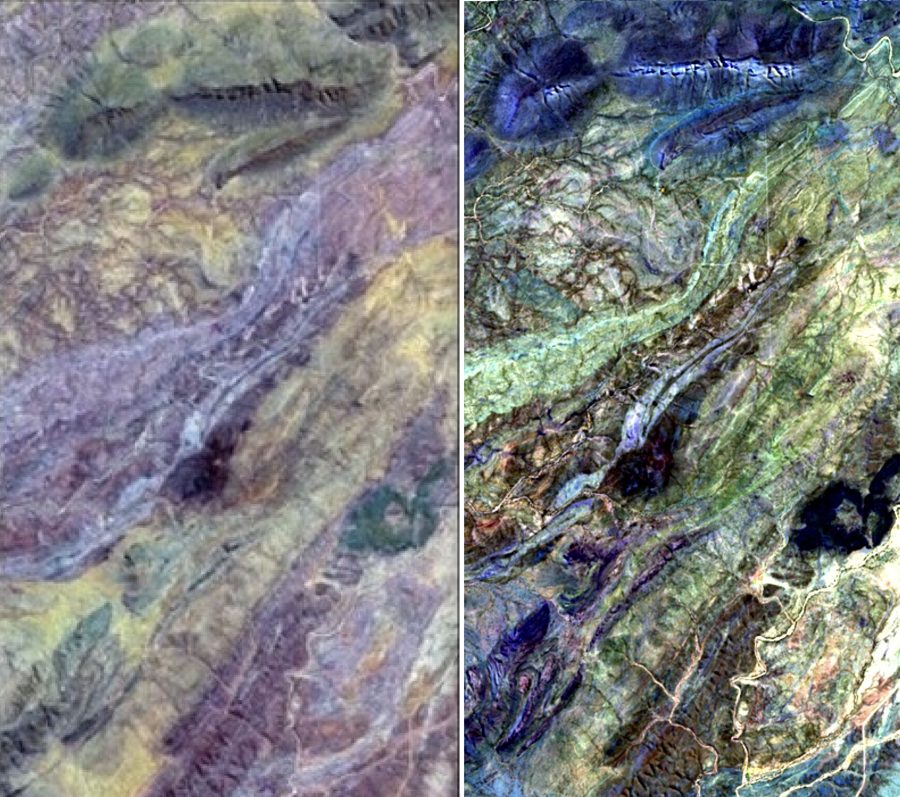
Hydrothermal alteration mapping is the foundation of mineral-exploration targeting. Until recently it required tasking WorldView-3 — expensive per-scene fees plus heavy interpretation cost — and only one satellite could do it. WV-3 reached end of life in December 2025 with no replacement.
EarthToDate fills the gap with enhanced Sentinel-2 at 2–4m, processed into four alteration indices (ferric iron, iron-species discrimination, hydroxyl/clay, ferrous/propylitic), an adaptive composite score, temporal confidence layers, and a seven-class alteration map — all worldwide, from a deep archive back to 2017, with no tasking queue.
At 2–4m, fault-hosted alteration corridors, small outcrops, concentric zoning, and excavation scars become classifiable — spatial patterns that are diagnostic of structural control and hydrothermal centres, yet sub-pixel noise at native 10–20m. Sentinel-2's narrow VNIR bands even out-discriminate WV-3 for iron species, while B12 SWIR at sub-5m exists nowhere else.
The geologist gets two complementary views: a classification confirming which alteration system is present, and a composite intensity gradient pointing toward the mineralisation core — an objective, reproducible ranking of which targets to drill first.
Frequently asked questions
What is Surface Mineral Map?
Hydrothermal alteration mapping is the foundation of mineral-exploration targeting. Until recently it required tasking WorldView-3 — expensive per-scene fees plus heavy interpretation cost — and only one satellite could do it. WV-3 reached end of life in December 2025 with no replacement.
What data and resolution does Surface Mineral Map use?
Ready-to-interpret alteration indices at 2–4m — the only sub-5m SWIR mineral mapping available since WorldView-3 retired. (2–4m hydrothermal alteration mapping)
How does Surface Mineral Map compare to the alternatives?
EarthToDate fills the gap with enhanced Sentinel-2 at 2–4m, processed into four alteration indices (ferric iron, iron-species discrimination, hydroxyl/clay, ferrous/propylitic), an adaptive composite score, temporal confidence layers, and a seven-class alteration map — all worldwide, from a deep archive back to 2017, with no tasking queue.