
Illegal Construction
New-build change detection
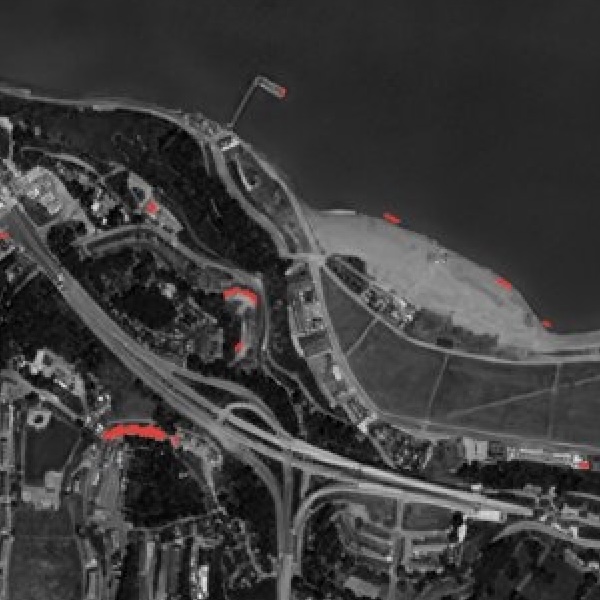
Unpermitted construction is hard to police because it is small, dispersed, and constant. By the time a structure is reported it is already built, and manual review of imagery across a whole jurisdiction is impractical.
EarthToDate detects new construction directly: pixels that classify as unambiguously built today but were not built some months ago. A land-cover classifier runs on both dates, and a three-stage filter suppresses false positives — asymmetric strictness (the new date must be strongly artificial while any prior built hint is ignored), spectral confirmation (a real NDBI or brightness rise, not an alignment artefact), and a minimum component size that trims noise specks while keeping genuine small buildings.
Running on enhanced 5m super-resolution imagery, it resolves individual structures — a 10×10m house is several pixels — across areas up to 100,000km², on an annual monitoring cycle. Outputs are georeferenced change layers plus per-site report views pairing the earlier and later dates over an OSM reference.
Planning authorities, land registries, and tax offices use it to find unpermitted development, verify declared construction, and prioritise enforcement without flying or driving the whole territory.
Frequently asked questions
What is Illegal Construction?
Unpermitted construction is hard to police because it is small, dispersed, and constant. By the time a structure is reported it is already built, and manual review of imagery across a whole jurisdiction is impractical.
What data and resolution does Illegal Construction use?
Pixels that are built now but weren't months ago — automated detection of unpermitted construction at national scale. (New-build change detection)
Where and how often is it available?
EarthToDate detects new construction directly: pixels that classify as unambiguously built today but were not built some months ago. A land-cover classifier runs on both dates, and a three-stage filter suppresses false positives — asymmetric strictness (the new date must be strongly artificial while any prior built hint is ignored), spectral confirmation (a real NDBI or brightness rise, not an alignment artefact), and a minimum component size that trims noise specks while keeping genuine small buildings.