
GLOF Early Warning
Glacial Lake Outburst Flood
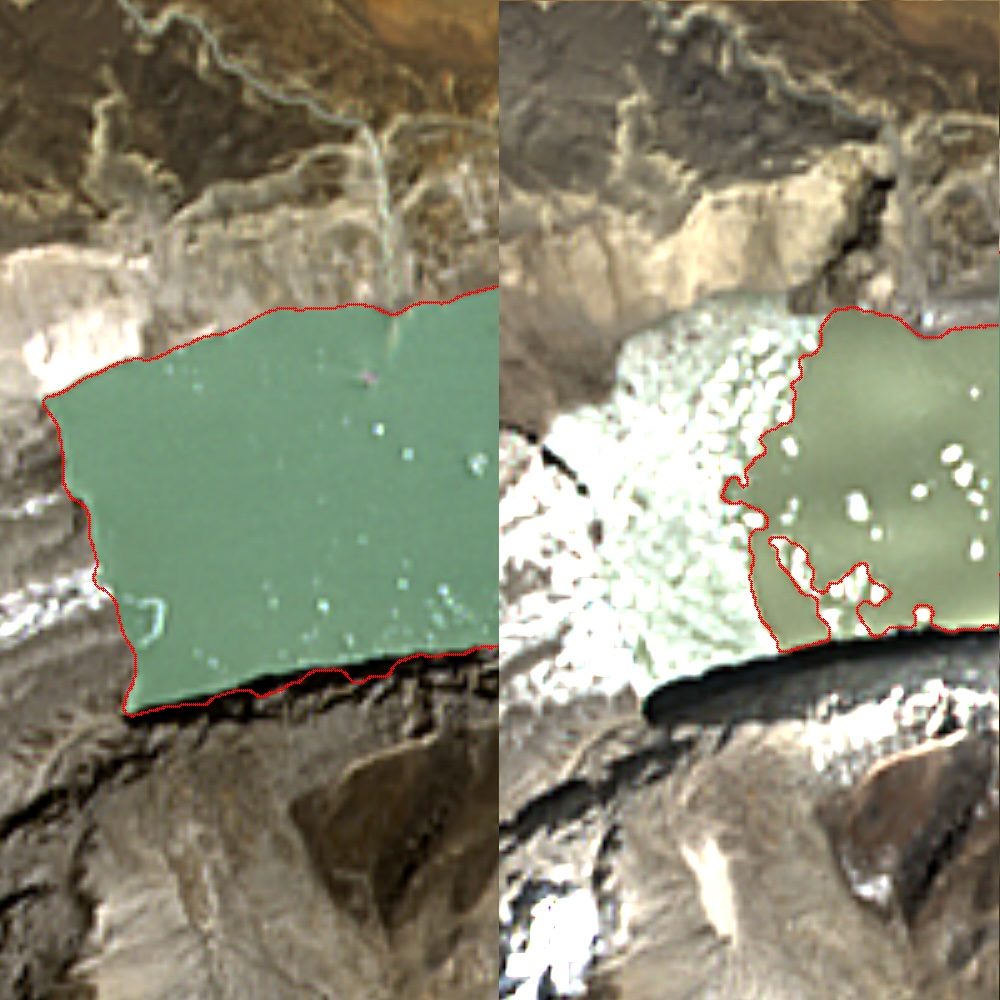
Glacial Lake Outburst Floods are among the most destructive mountain hazards, yet most agencies still rely on total lake volume — which is not what determines downstream impact. What matters is the volume that would actually discharge if the moraine breaches, and where that water would travel.
Current assessments combine empirical area-volume scaling with 5–30m public DEMs, producing error bands too wide to plan against and no usable inundation modelling. EarthToDate measures the right quantity: releasable discharge volume, derived from enhanced 1m true-colour and 2–4m multispectral imagery over a globally-validated 1m BaseDEM.
For each monitored lake ETD delivers a discharged-water estimate, surface-extent and volume tracking from Sentinel-2, terrain-driven downstream flow simulation across villages, roads and bridges, growth-rate anomaly alerts, and a full historical baseline from the Sentinel/Landsat archive. The methodology is patent-pending.
It works for any glacial lake on Earth — Himalaya, Andes, Caucasus, Alps, Patagonia — delivered as API, GIS layers, or a hosted dashboard for disaster-management and hydrological agencies.
Frequently asked questions
What is GLOF Early Warning?
Glacial Lake Outburst Floods are among the most destructive mountain hazards, yet most agencies still rely on total lake volume — which is not what determines downstream impact. What matters is the volume that would actually discharge if the moraine breaches, and where that water would travel.
What data and resolution does GLOF Early Warning use?
Continuous glacial-lake monitoring that models the water actually discharged downstream — not just total lake volume. (Glacial Lake Outburst Flood)
Where and how often is it available?
Current assessments combine empirical area-volume scaling with 5–30m public DEMs, producing error bands too wide to plan against and no usable inundation modelling. EarthToDate measures the right quantity: releasable discharge volume, derived from enhanced 1m true-colour and 2–4m multispectral imagery over a globally-validated 1m BaseDEM.